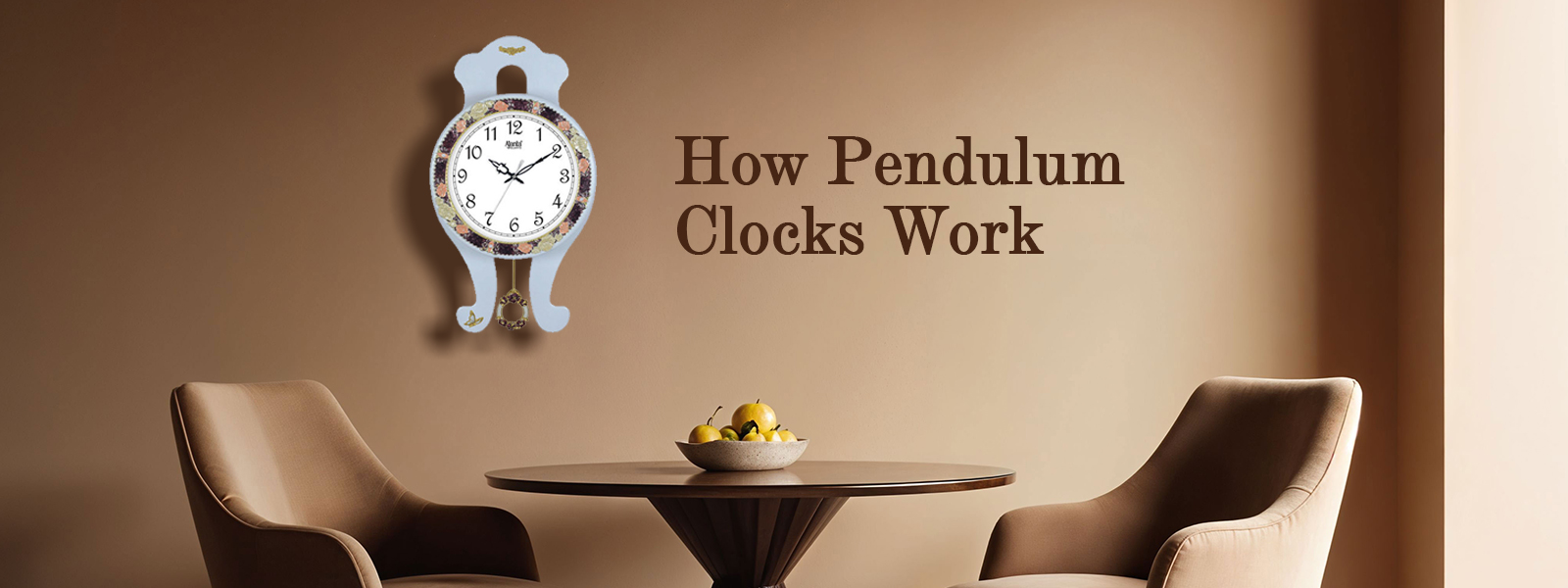
Pendulum clocks are mechanical devices that tells time. They are known for their rhythmic swinging and constant ticking sound. People want to know how does a pendulum clock work simple theory and what makes them different from other types of clocks. Knowing how these work helps us appreciate how well they were made. Pendulum clocks are still a popular decorative item that serves its purpose, whether in living rooms or hallways.
Understanding the mechanics behind these timepieces helps us to appreciate the craft in their design. Whether in living rooms or hallways, pendulum clocks remain as a enduring decorative element serving the intended function.
The Basic Principle Behind Pendulum Clocks
To get a fair idea how pendulum clocks work, it is vital to flook at the role of the pendulum itself. A pendulum is a heavy object that hangs from a fixed point and swings back and forth because of gravity. This constant motion sets a regular time interval, which controls how the clock moves.
The pendulum oscillation controls the pace at which the clock’s gears move. Each stroke allows the gears to move forward marginally, generating the well-known ticking sound. As a result of this, the clock measures seconds, minutes, and hours with accuracy.
People who are inquisitive and interested to know about pendulum clocks how does a pendulum clock work simple theory and find it interesting that this simple swinging action forms the base of precise mechanical timekeeping.
Main Components of a Pendulum Clock
Several components are put together to make the clock function rightly. These parts form the mechanical system that keeps the clock ticking.
The pendulum is the most obvious part, and it keeps time. The clock also has gears, weights or springs, and a way to break out. The weights or springs give the clock the power it needs to keep running, and the gears move energy through the system. When you learn how a pendulum clock works, it’s easier to picture the clock as a system that is carefully balanced. The weights or springs store energy that moves the gears. The pendulum controls how fast the gears turn and move in small, controlled steps.
The Role of Gravity and Motion
Pendulum clocks are fundamentally dependent on the force of gravity for their function. As the pendulum moves, gravity works to bring it back to its resting position, first pulling it toward the center and then pushing it to the other side.
This back-and-forth motion allows a gear tooth to be released with each swing, which in turn moves the clock’s hands forward.
Why Pendulum Clocks Need Winding
Conventional pendulum clocks need winding because the energy they store slowly runs out over time. Also, as the clock works, the weights go down or the springs unwind. Winding the clock reintroduces energy into its mechanism. The gears then continue their motion, and the pendulum begins its rhythmic swing. This act of winding is essential for the clock’s continued operation.
If you’re wondering how a pendulum clock works, you can think of the winding process as filling up the clock’s energy source. The pendulum would stop swinging and the clock would stop working if it didn’t have this stored energy. Winding the clock regularly keeps it in sync and makes sure it keeps working well.
The Lasting Appeal of Pendulum Clocks
Pendulum clocks are still popular in many modern homes because their mechanical operation, steady ticking sound, and beautiful designs make people feel nostalgic and charming.
People who learn about how pendulum clocks work often come to appreciate the skill and artistry that went into making them even more. These clocks are a unique mix of physics, engineering, and art.
Many modern homes today choose decorative pendulum clocks to go with their decor. They also like the classic movement that has been used to keep time for hundreds of years. Orpat and other brands make pendulum clocks work well in modern homes.
Understanding pendulum clocks reveals how their precision hinges on the harmonious interplay of gravity, motion, and meticulously crafted mechanical components.
The clock’s rhythm is governed by the pendulum, and it’s the gears and escapements that transform accumulated energy into the exact tracking of time. These mechanisms, still both practical and visually appealing, find a place in modern homes. Much of this can be attributed to companies such as Orpat, which still crafts them with a focus on design.
Frequently Asked Questions
To answer pendulum clocks how they work – they come with a swinging pendulum that pscilattes at steady speed that moves the clocks hands move forward and work.
The pendulum works as a regulator that oscillates telling us time consistently.
Pendulum clocks works mechanically by storing energy in the weights or springs which makes the clocks’ gear work with every oscillation.
Pendulum clocks work accurately if maintained well.
When a pendulum stops working, the clock will also stop working as the oscillation of the clocks makes the clocks gear work and the hands move forward.